The basics
Auction Empires is a property auction game. Homes go under the hammer one after another on a street full of rival bidders. Each auction runs for about ten seconds (fifteen while you're new), and every time someone bids, the clock resets a little. When the clock runs out, the highest bid wins.
You start with $450,000 and a Starter market of units and small houses. Every home you win pays rent each month, and in the game a month is one second. Your net worth climbs, bigger markets open, and the auctions get bigger with them: Family homes, Prestige, Trophy and finally Icon estates worth hundreds of millions.
Read the valuer, set your walk-away
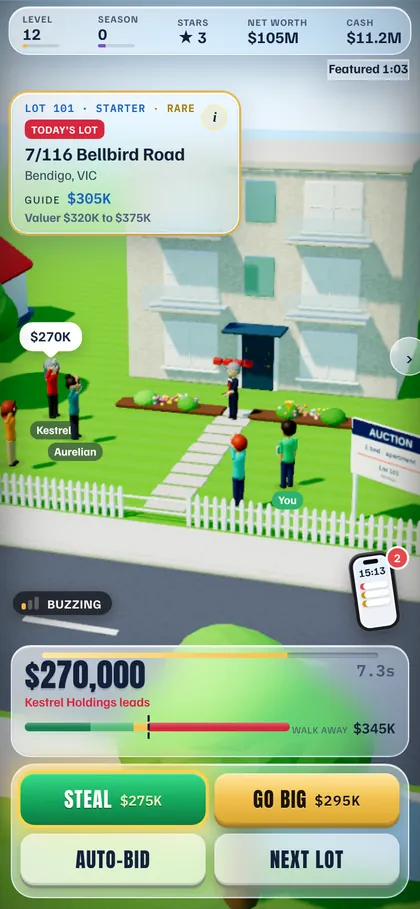
Every lot shows a price guide and the valuer's range, for example "Valuer $405K to $475K". The guide is the agent's number and is usually low. The valuer is closer to what the home is really worth.
The middle of the valuer's range is your walk-away line. Win under it and you're richer the moment the hammer falls, because the home is worth more than you paid. Win over it and you've overpaid.
The meter: Steal, Good, Fair, Overpaying
As the price climbs, a marker moves along the meter under the price so you never have to do the maths mid-auction.
The four buttons
- Bid raises the price by one step. When the next bid is a steal, the button says so.
- Go big jumps several steps at once. A jump bid can scare cautious rivals out of the room and gets the crowd talking.
- Auto-bid bids for you up to a limit you set, then hands the paddle back at the final call so you decide the last bid yourself.
- Next lot skips to the next auction. Skipping is free; not every house is worth fighting for.
If you can't afford the next bid, the button reads Need $…. Tap it to borrow against the homes you already own, sell one, or see your options.
Rivals and bidding wars
Every bidder in the crowd has a private limit. Most drop out when the price passes what the home is worth to them. About one lot in five has a stubborn rival who will go a little past value, and some rooms are quiet, with nobody willing to pay much over the guide.
Beat the same rival enough times and they become your nemesis; they'll turn up at your featured auctions looking for revenge. When two rivals go back and forth, or you trade bids with one, the room heats up from Buzzing to Heated to Electric and the crowd starts filming.
After the hammer: inspection and cards
Every home you win gets inspected. Most are clean, some hide a good find, now and then there's a flaw, and occasionally a jackpot: a hidden granny flat or a much bigger block than advertised. Featured auctions have better odds.
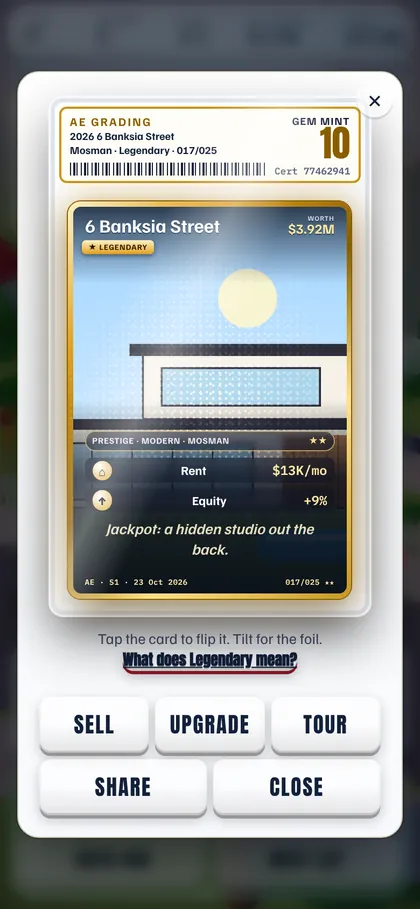
Each win also becomes a collector card, rated Common, Sought-after, Prime, Epic or Legendary. Rarity comes from the deal itself: how far under value you won, the inspector's find, a featured lot, beating your nemesis. Epic and Legendary cards are graded and slabbed. Fill a page of your binder by owning a home in every suburb of a market.
Build your empire
Rent and costs
Each home pays rent every month, minus council rates, upkeep, strata for units, insurance if you've taken it and interest on any loan. Your phone shows your income after costs, and the Money app breaks it down.
Suburb sets
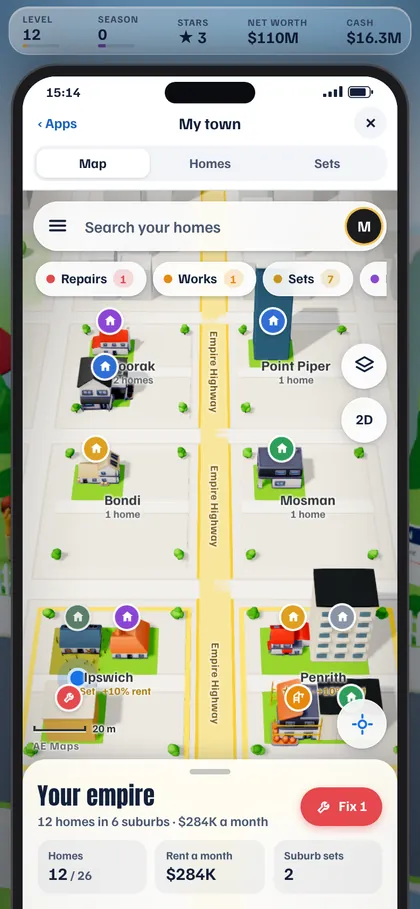
Own three homes in one suburb for +10% rent on all of them, or two on the same street for +5%. Five in a suburb unlocks a takeover. Sets are often worth paying a fair price for.
Upgrades and rebuilds
Give a home a makeover, add a pool or an extension to lift its value; enough upgrades move it up a category. With enough land you can knock it down and build a duplex, a row of townhouses, an apartment block or a mansion. Builds take real minutes, can run over budget and can be delayed, but they usually double the value or more.
Tenants and repairs
Tenants send repair requests and the odd wish list. Fix repairs quickly: ignored ones cut the rent, and after a while the tenant leaves and the home runs down. A property manager fixes everything as it comes in, at a small markup.
The Market and off-market deals
Prefer a sure thing? The agent's window lists homes you can buy straight away at a small discount. You get ten Market buys, refilling one every two minutes; auctions never run out. Agents also phone with off-market deals and offers on homes you own, and they don't wait long for an answer.
Events
Floods, storms, bushfires and cyclones hit real hazard zones, so a coastal home carries different risks to one inland. Insurance covers the damage, and every disaster is followed by a rebuild boom in that suburb. Good news lands too: suburb booms, rate cuts, celebrity neighbours, and tenants with stories of their own.
Levels, seasons and stars
- Level: every lot you join, win or tour earns XP. Every fifth level pays a cash drop, and levels add portfolio slots.
- Season: a 100-tier track that resets on the first of each month, with a free home every ten tiers.
- Stars: once you pass $100 million you can cash out your empire for stars. You start again with more cash and more rent for good. Fifty stars earns the Gold dynasty mark, and the marks keep going from there.
Friends and live auctions
Start a group and share the code. You'll race in a weekly league, duel on the same lot, and meet on Thursday nights at 8pm for Auction Night. Every few minutes the live arena opens: everyone online bids on one rare home against each other and the house rivals, and the winner's name goes up on the board.
Ten tips for your first hour
- Take every Steal. Early rooms are often quiet.
- Don't chase past the walk-away line unless the home completes a set.
- Use Go big when one rival is left; it often ends the auction.
- Skip lots you can't win comfortably. The next one is ten seconds away.
- Keep a deposit in cash for the next tier up.
- Fix repairs before they cut your rent.
- Build sets in cheap suburbs first; +10% on many homes adds up.
- Insure homes in flood and bushfire zones.
- Turn on auto-bid with a sensible limit when you're juggling the Market.
- Cash out at $100 million. The stars make every future empire faster.